
The principle of reflow soldering is to use the high temperature airflow and temperature in the reflow oven to solder the components on the printed circuit board (PCB) to the PCB. Reflow ovens usually consist of a heating zone, a holding zone and a cooling zone, where the heating zone can reach temperatures of 200°C to 300°C and the holding and cooling zones have corresponding cooling control systems to ensure the quality of the component solder joints and the stability of the board. In the reflow process, the solder paste is heated to a liquid state, then connected to the board via the solder pins on the components and cooled to a solid solder joint.SMT Machine
The specific process of reflow soldering is as follows:
Firstly, the solder pins on the PCB need to be coated with solder paste, usually using printing techniques to process the paste into the required size and shape, and then the electronic components are pasted onto the PCB. This process is usually carried out by a machine, which is much more efficient than doing it manually and avoids operational errors.Welding Robot
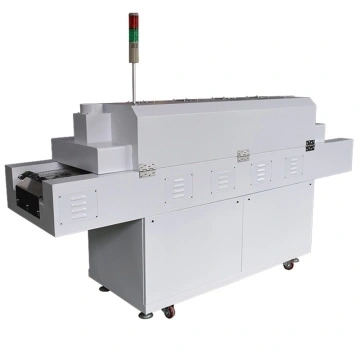
Next, the PCB enters the holding and cooling zones. In the holding zone, the PCB continues to remain hot so that the solder joints can fully penetrate the gaps in the printed circuit board. The PCB then enters the cooling zone, where the board is cooled to room temperature to allow the solder paste to become solid again. This process usually takes a few minutes and the length of time is adjusted according to the size of the PCB and the solder joint.
Finally, the finished electronic components can be subjected to a series of tests and quality checks to confirm that they meet standard specifications.
Reflow soldering is used in a wide range of applications, from mobile phones and tablet PCs made from thin-film circuit boards to high-end electronic equipment such as large servers and medical equipment, for safe and reliable circuit connections. Although the process of reflow soldering requires a certain level of expertise and skill, with the right training and education, even beginners can master the process.
In conclusion, reflow soldering, as an advanced electronics manufacturing technology, has been widely used worldwide and plays a key role in the production and quality improvement of electronic products.